This phrase was immortalized by Tom Cruise in the movie Jerry Maguire. Maguire is a professional sports agent who has one client, wide receiver Rod Tidwell (played by Cuba Gooding Jr.). In one scene, Maguire is exasperated at the antics of his only client, pleading with Tidwell to understand how hard it is for an agent to land the big contract extension and endorsements for a player. “Help me, help you!” he repeats, over and over again.
I want to invite you into this journey of coaching and caring for leaders by saying:
“Help me, help them.”
Help me help those in leadership.
My desire is to guide leaders towards health and wholeness.
Helping them rediscover the unique design and purpose of their leadership.
So, let me ask you:
What things do you think are needed for leaders to be refreshed?
How do leaders need to receive care?
What do you think is one of the greatest needs for your pastor?
What tools have you used that have helped you discover how you are uniquely made?
What things combined to make you discover your primary calling or purpose?
What do you think leaders need to guard against that might draw them away from that primary purpose?
Pick any or all of these, and please send me a message…I’d love to know your thoughts! I want to be well-equipped to help those in multiple spheres of leadership.
You can also help me help them by giving financially. I’m currently at 70% of my monthly goal of financial support. Once I reach the “fully funded” mark, I’ll be able to receive more leaders that are reaching out to Standing Stone for this kind of help. On a regional Zoom meeting I was on recently, we heard from our area director that they are seeing a marked increase in pastors asking for help on their website forms.
So, help me help them!
I look forward to hearing from you.
[You can email me at david.burke@standingstoneministry.org]
Last week, I wrote about why leaders—and perhaps ministry leaders in particular—don’t seek the help of counselors, therapists, spiritual directors, or coaches. Those 3 reasons were:
Sunday is always coming.
It feels “selfish” to take care of yourself.
Cost and expense.
This week, I want to offer three more reasons why these leaders find it so hard to ask for help. There are probably a myriad of reasons, but these are a few that hit home.
It feels like “weakness” to admit we need help. Sure, we can preach on a passage that says, “When I am weak, then I am strong,” but actually confessing our exhaustion, need for rest, or feelings of isolation can make us worry that people might think we are not capable as leaders. Leaders are supposed to exude certainty and strength, right? What happens when we are uncertain and feel depleted?
Sometimes we live in an organizational culture that is marked by overwork. We may work amongst those that are always doing more, staying later, and will do whatever it takes to move the mission forward. To be the one staff member who is asking for time off, a sabbatical, or just a day to regroup after a hectic season can feel risky, and we might feel something is “wrong” with us when we longing for recovery time.
Do we believe that just “talking about it” will really help? We have most likely been asked the question: “Does prayer really DO anything?” Likewise, we might wonder if just talking to someone will really “do” anything to help. Sure, people might come to us, seeking counsel, wisdom, compassion, and prayer. But do we trust that going to someone else for the same things will be worth it?
I want to help guide leaders towards their wholeness, by helping them discover—or re-discover—their unique design and purpose.
I am now serving with a ministry called Standing Stone, which has aimed for twenty years to provide a space for free, confidential coaching and care for pastors, ministry leaders, and leaders of every sphere. Standing Stone believes that healthy leaders need companions on their leadership journey, and that healthy leaders will lead healthy organizations that help transform their communities. You can learn more here: https://standingstoneministry.org/shepherd/burke-david/
In 2015, 38% of pastors used to seek out help from therapists, counselors, spiritual directors several times a month. Now, according to the most recent Barna research, only 18% do. Why is that?
Leaders in other spaces seem to be growing in their awareness of needing help. According to this study, 32% of chief executive officers seek the help of an executive counselor, and 22% receive assistance from a psychologist or therapists. Here are three reasons why I think pastors in particular don’t seek out help from counselors, therapists, spiritual directors, or mentors.
First,
Sunday is always coming.
The rhythm of leading worship and preaching every week is constant. And, attendance at those weekly services may be one of the few tangible markers pastoral leaders have in measuring the effectiveness of their ministry. The internal pressure to be prepared for weekly worship is heavy.
While some preachers make public speaking look effortless, research has shown that it takes a toll on people. Archibald Hart has written about the “adrenaline let down,” a physiological phenomenon that brings fatigue, emotional depletion, and a sense of emptiness.
Pastors and ministry leaders may learn to “push through,” and not address these recurring symptoms of stress, because “Sunday is coming.”
It feels “selfish” to take care of yourself
I took a cross-country flight recently. This might be an overused analogy, but you may have heard this: “Put on your own air mask before helping others.” The lesson here is simple: if we don’t take the time to keep ourselves healthy, we will not be able to really help others.
Those in all helping professions probably have something within them that is geared to notice others’ needs and move to bring healing to them. Ironically, those same people may not be tuned to notice their own needs. Could it be that the internal and external rewards they receive from being a help to others outweigh the voice that tells them to slow down and take care of themselves?
The season of the Covid pandemic forced so many leaders to adapt quickly. Then, when things normalized, there was tremendous pressure for church leaders to “get people back to church again.” Many churches haven’t fully recovered. To take time away for help feels selfish in the midst of unfinished work.
There is also still a lingering stigma of counseling, or therapy. Leaders may wonder if others are asking: “Why would a person whose calling is to direct a group of people spiritually need their own spiritual director?”
Cost and expense
It was both the encouragement, and the generous financial gift, of one couple in the church that I served that got me to consider getting help from an executive coach. The two coaches that I ended up working with helped me immensely over the course of four years. If I had to pay for that out of my own pocket, I don’t believe I would have pursued it. With a large family, making ends meet was already a challenge. Having never had a coach before, I’m not sure I could have justified the expense because I didn’t yet know the benefits.
Those coaches (here and here!) gave me a space to talk openly and honestly. I learned a great deal about myself and how I get in my own way in leadership. They asked powerful questions, helping me discern so many things, and bring a healthier version of myself into leadership.
Their influence was a help in me deciding to become a coach myself. My hope is to find those who are willing to invest in their own life and leadership health and guide them into a greater wholeness.
I am now serving with a ministry called Standing Stone, which has aimed for twenty years to provide a space for free, confidential coaching and care for pastors, ministry leaders, and leaders of every sphere. Standing Stone believes that healthy leaders need companions on their leadership journey, and that healthy leaders will lead healthy organizations that help transform their communities. You can learn more here: https://standingstoneministry.org/shepherd/burke-david/
“How many people were there?” This is a question being asked in thousands of churches this week. Holy Week and Easter meant as many as four major events in four days for many church leaders. Maundy Thursday, Good Friday, Easter Vigil services, and then Easter morning, with some having both sunrise and traditional morning services. I hope you and your loved ones had a wonderful Holy Week and Easter celebration!
In the 25 years I served as a pastor, I remember how church staffs would often look this week at the “numbers” from the last week of services. How many people attended this year? After the years of Covid, where people’s in-person attendance habits changed, are we seeing a return to “pre-pandemic” times in our services?
In this month’s newsletter, I want to look at some other numbers.
60, 19, 73, 54, 75, 65
Lottery numbers? I wouldn’t try them if I were you!
No, they are both numbers that reflect the need of providing care for pastors and other non-profit leaders in this time, and some numbers of gratitude from me!
The first four numbers come from a webinar I attended several weeks ago called, “The State of Pastors,” by the Barna Research Group. First, 60%–refers to the percentage of pastors reporting that they are doubting their sense of calling to being a pastor. The last few years of leadership have caused many to wonder about their sense of vocation. 19% refers to pastors who now see a mentor or other support person (including counselors, therapists, spiritual directors) several times a month…this is down from 37% in 2015. 73% of pastors report being emotionally and spiritually exhausted “frequently” or “sometimes,” while 54% report feeling lonely and isolated. Clearly, there is a great need for leaders to have someone to safely share their struggles and to come alongside the loneliness in leadership.
The last two numbers are “my numbers!” 75 is the number of people that are currently supporting me financially in this new season of helping leaders become whole. I am so grateful for the individuals and families that have said “Yes” to helping me offer coaching and care for free to these leaders through Standing Stone. And 65% is now where I am in monthly support! Thanks to many of you and your generosity, I am well over halfway towards my goal to provide for me and my family. I am looking forward to reaching the “full-funding mark”, when I can devote all my time and energy to meeting with and caring for leaders.
Founders of Standing Stone Ministries, Jim and Debbie Hogan. I was in Upland California for two days of meeting and resourcing for 50 of us doing this work, and had the opportunity to meet the founders!
I am now serving with a ministry called Standing Stone, which has aimed for twenty years to provide a space for free, confidential coaching and care for pastors, ministry leaders, and leaders of every sphere. Standing Stone believes that healthy leaders need companions on their leadership journey, and that healthy leaders will lead healthy organizations that help transform their communities. You can learn more here: https://standingstoneministry.org/shepherd/burke-david/
“It sounds as if you’re more like the Queen of England.”
A coach for pastors told me about this phrase and phenomenon. With all due respect to the departed Queen, God rest her soul, the “Queen of England” moniker is when leaders are asked to play performative roles, but not expected or wanted to lead the institution or organization. We have others terms for this—“figurehead,” “mouthpiece,” and “leader in name only.”
I chose the picture above because it shows the singular swan, swimming amongst others…Canada geese. As I watched these birds that day, I remember watching how no one was paying particular attention to the swan. The geese swam around in their group, and kept to themselves. Over time, the geese swam off into an entirely different body of water, and the swan was left alone.
I found it interesting to later learn that mute swans were brought over from other parts of the world to decorate estates, ponds and lakes. Consider these words:
All of the Mute Swans in North America descended from swans imported from Europe from the mid 1800s through early 1900s to adorn large estates, city parks, and zoos. Escapees established breeding populations and are now established in the Northeast, Midatlantic, Great Lakes, and Pacific Northwest of the U.S. (https://www.allaboutbirds.org/guide/Mute_Swan/overview#)
Swans in North America were decoration. Much like some leaders may be decoration for an organization or institution, mute swans find themselves now in natural settings, but are not native to that land. You have to wonder if some of the native birds in our rivers and lakes keep their distance from these “decorative” neighbors, instinctively knowing, “You’re not from around here, are you?”
I found it interesting that the AllAboutBirds website referred to these mute swans as “escapees.” When the mute swans “escaped” from their estates, parks, and zoos, they established themselves in other environments. I wonder how many leaders wish to escape their present environments, tired of “adorning” their organization?
I recently watched a “State of Pastors Summit” put on by Barna Research. As of September 2023, 33% of pastors surveyed were considering quitting ministry, and 60% were doubting their sense of calling. 75% of C-Suite Executives, managers, and employees in July 2023 were considering quitting their current role for a role that focused more on their well-being, according to a survey of 3,150 people by Deloitte. Admittedly, these statistics may not be solely tied to leaders feeling like “decoration,” but we are seeing a great time of reflection and reassessment among leaders in the faith-based space and corporate world. Underneath these statistics may be a prevailing sense of wanting to be cared for and valued.
In my last post, I spoke of Jesus teaching us to “consider the birds of the air.” This is what I’m learning by watching the swan. Jesus would go on to say that we are to see how God provides for the birds, so we can rest in the knowledge that we will be cared for as well—for we are of much more value in God’s sight.
The walks down by the American River here in Sacramento brought me time to reflect…and capture more photos of this singular swan. Pictures like the one above (I’ve got many!) show me many things. Last month, I mentioned the loneliness of leadership. 70% of pastors report NOT having someone they consider a close friend. (Barna, 2023). Harvard Business Publishing reports that same 70% among new CEOs.
Harvard Business Publishing noted that more than 70% of new CEOs report feelings of loneliness, a sentiment not exclusive to them but prevalent across various leadership levels. Loneliness is particularly acute among individuals newly promoted to leadership positions. The implications of such loneliness are profound, likened to the health impact of smoking 15 cigarettes a day. (From the Perceptyx blog)
The importance of having someone walk alongside us in leadership cannot be underestimated. To have someone listen to us when we feel “muted” is crucial. I have learned that this swan is a “mute swan,” so named because it is less vocal than the aptly named “trumpeter swan.” It is not that the mute swan is completely silent. It is simply “less vocal.” For me personally, that phrase resonates. Moving from speaking nearly every week to hundreds of people to a posture of listening has already made me notice several things. The rise and fall of adrenaline in my body has changed. (Though I have still had dreams of getting up to speak and not being prepared—that raises my adrenaline!).
Something else I have recognized is this: how much I have relied on my many words—even in my family—to bring about change. I have believed that if I just have the opportunity to explain myself more, use the right metaphor, illustration, and tie it all together with a powerful story, that everyone will see things my way! Being ‘less vocal’ might also be a good posture for leaders in general. To listen first, be “slow to speak,” and not rely solely on leadership by voice may be what is needed in this moment.
I have heard from other leaders throughout the years, and experienced myself, the feeling of being “muted” in leadership. Whether it is not knowing how to lead with clarity, or trying to speak for what needs to change and it coming across wrong, or being misunderstood, leaders in every sphere can feel muted.
The work I am aiming to do among leaders has a certain silence about it. That is, because it is confidential care and coaching, I cannot share all the details of stories of this ministry. For these reasons and many more, I think God might have placed this mute swan on this little body of water to get my attention. After all, wasn’t it Jesus who said, “Consider the birds…”
I am now serving with a ministry called Standing Stone, which has aimed for twenty years to provide a space for free, confidential coaching and care for pastors, ministry leaders, and leaders of every sphere. Standing Stone believes that healthy leaders need companions on their leadership journey, and that healthy leaders will lead healthy organizations that help transform their communities. You can learn more here: https://standingstoneministry.org/shepherd/burke-david/
One of my first photos of this single swan…(October 2023)
On the day I first saw the swan, I was entering into a time of transition. After 25 years of serving as a pastor, I was stepping away. I had just announced to the staff and elders of the church that I was serving that I was sensing an end to my time there, and moving into something new. The “something new” was a pull towards what a spiritual director told me earlier that year: “a longing for the hidden work of deep discipleship.” Every part of that phrase resonated with me. There was definitely a longing in me. I sensed it would be more of a hidden work. That is, in contrast to what I had been doing, often being the up-front communicator and leader, this new work would be more unseen. One-on-one meetings in coffee shops, restaurants, or offices. AndI have always believed that deep discipleship most often comes through those meaningful conversations and relationships over time where questions, fears, thoughts, doubts, and insights can be shared, challenged, refined and held. We see it as Jesus spent time with individual disciples and the community of disciples. I would come to interpret the words of that spiritual director as a returning to what I loved: listening with care to others describe where they were in their journey of leadership—whether that leadership be in the church, their work, their home, or family.
In this time of transition, I felt like that swan. While some understood this change of vocation, many did not. I also remember telling my co-workers that, while I had then three months left with them, already I was feeling not as much a part of the team. They would be continuing the work I had been a part of for more than nine years (and this church’s work in this city for 150 years!), but I was going to swim in different waters. I couldn’t see everything in my future clearly, and saw many things dimly. Nearly four months later, several things I felt more certain of have already disappeared from view.
As I saw the swan, swimming alone in that portion of the American River, I reflected on a larger loneliness of leadership. I had been in a group of other pastors that met yearly, and one of the things we frequently talked about was this: that no one really understood what it was we did. And that groups like that one was a balm for our souls, because we didn’t feel alone there. For a couple of days, we shared our joys and struggles, laughed at each other’s stories, wept with one another in our pain. The harder part came when we returned home. Yes, we could call one another, but we weren’t WITH one another in the same way.
What would it look like to have someone do the same thing with us where we were? That is what began to take root in my mind and heart. As I watched the swan swim alone, I thought of how many leaders were swimming alone. I wanted to help, starting by practicing the art of listening for the loneliness of leadership.
I am now serving with a ministry called Standing Stone, which has aimed for twenty years to provide a space for free, confidential coaching and care for pastors, ministry leaders, and leaders of every sphere. Standing Stone believes that healthy leaders need companions on their leadership journey, and that healthy leaders will lead healthy organizations that help transform their communities. You can learn more here: https://standingstoneministry.org/shepherd/burke-david/
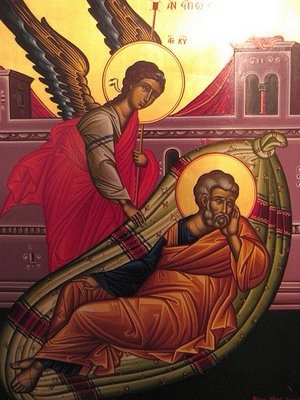
“Mary will bear a son, and you shall call his name Jesus, for he will save his people from their sins.” Matthew 1:21
Names were important in the Bible. Often they associated someone with their family heritage. God often told the prophets to name their children as a message—Isaiah named one of his children, “A remnant shall return.” Here, an angel tells Joseph to name this child Jesus—which means “The Lord saves.”
There are three questions we’ve looked at so far in this Advent series:
“How can I be sure?”—asked by Zechariah
“How will this be?”—asked by Mary
“Where is he?”—asked by the Magi
These are the questions of our neighbors, co-workers, and classmates who may not know of Jesus, or are not seeking to follow Him. Let’s recall: before any of us took a step of faith, we wanted to be sure, we wanted to understand how it all works, and we wanted to know where to go. The questions asked in the Christmas story are our questions too.
The “what” of the name Jesus answers the “Why.” God sent Jesus into the world to save. Some of us might feel we don’t need saving, but we do. The things we’ve done and said, the things done to us that we can’t fix. The things we regret and have left undone. All of us need rescue from the rumination about what might have been.
This Christmas season, let’s remember the name—His Name is Jesus. Let’s remember the why.
“Where is he who has been born king of the Jews?” Matthew 2:12
“Where are you, God?” This might be one of the quintessential questions of the human condition. We ask it in times of uncertainty and sadness. We ask it in times where we need wisdom and assurance. We ask it because we cannot see God face-to-face, or we cannot feel His presence.
The Christmas story records this question too. But the people asking it WOULD indeed see God face-to-face. It is a group of Magi—traditionally called Wise Men—traveling from another country and culture, asking where they can find the newborn king, so they can pay homage and present gifts to Him. They literally wanted to know the place and time. And they found Him, lying in a manger. The Magi glimpsed the good news of the gospel—that God Himself would come to us in Jesus Christ from the heavenly places, giving up glory and experiencing the joys and sorrows of being human. He came to save us, and it all started in an unlikely place.
Let’s be honest: in the busyness of this season, it can be easy to lose sight of God. It is possible to fill our calendars and to-do lists with so much that we might ask, “Where is God in all of this?”
The answer is: you can find God in the story of Christmas. God so loved the world that He sent His one and only Son. Born in Bethlehem, born in a manger. When humanity was crying out to find God, God came to find us.
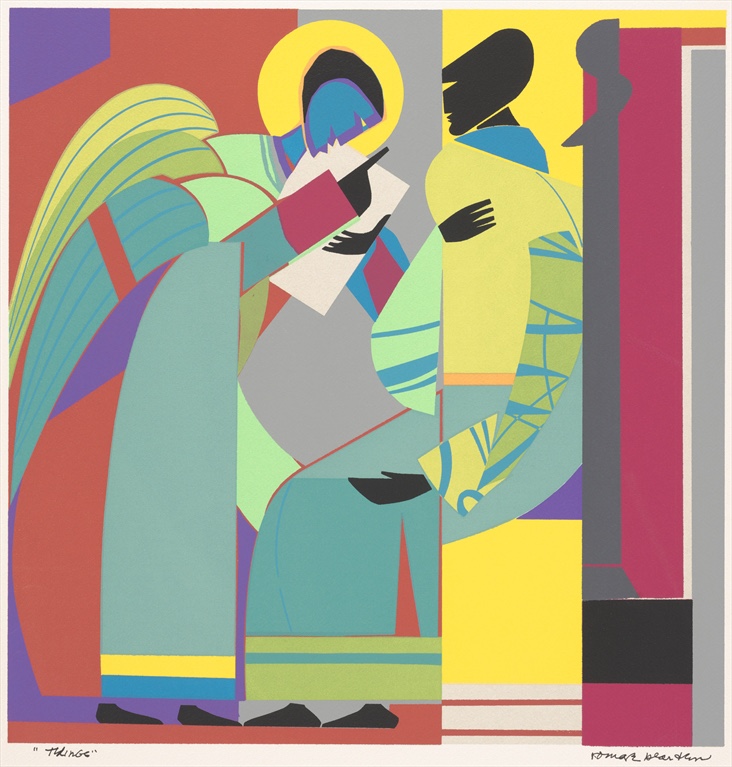
Romare Bearden (American, 1911-1988) Tidings, ca. 1970
Mary asked the angel, “How will this be?” Luke 1:34
The Christmas story is unusual. Last week, I wrote about God doing something out of the ordinary with Zechariah and Elizabeth, the couple who would raise John the Baptist—the one set apart to prepare the way for Jesus. Now, God sends an angel to Mary.
With Mary, we get another question in the Christmas story. “How will this be?” Or, “How can this happen?” Mary goes on to literally say, “Since I have not known a man?” There is a “usual way” of a child being conceived and born. God chooses a one-of-a-kind way. God’s Holy Spirit will “overshadow” Mary—the Greek word is a word that also gets used in Acts 1:8–“You will receive power when the Holy Spirit comes upon you.” Then, to emphasize the unusual ways of God’s work, the angel tells Mary that her relative Elizabeth is going to have a child, even in her old age. As if to say, “God is doing a lot of strange things!”
Mary isn’t the only one to ask the question, “How can this happen?” In the gospel of John, there’s the story of a man named Nicodemus, who asks that kind of question, not once, but twice. Is it out of that conversation with questions that Jesus says these famous words: “For God so loved the world that He gave His one and only Son, that whoever believes in Him shall not perish, but have eternal life.”
Because we tell and re-tell the Christmas story every year, it can be easy to gloss over the unusual parts of the story. We can miss the fact that the characters in the center of the Christmas story had real questions! As we share this story with our family, neighbors, co-workers and classmates, let’s not dismiss the fact that they might have questions! “How could God become one of us?” The “how” is certainly hard to explain. The “why” is simpler: Because of His great love for us.
Let’s not miss the wonder and miracle of all of this.







 david j burke