Resistance is Futile…and Normal? Or, Why Green Lantern is my favorite.

Ok, stay with me here. This is going down the rabbit hole of my brain a bit. I swear I remember watching “The Super Friends” cartoon as a kid, and I thought villain Lex Luthor said, “Resistance is Futile.” He and his cronies in the Legion of Doom were trying to take over a city, or the planet Earth, and they broadcast their sinister plot over some loudspeaker to the innocent citizenry. Side note: I often get mocked by my peers when I admit that my favorite SuperFriend was Green Lantern. The movie starring Ryan Reynolds didn’t help my cause at all. Just check out the reviews. Why did I like the Green Lantern? I don’t know, maybe because he wasn’t one of the main characters but often helped in key situations. Maybe it was the fact that it was whatever he imagined that turned into reality. I’ve got the Green Lantern T-shirt and everything. Anyway, back to Lex Luthor and “Resistance is Futile.” Turns out, Lex Luthor didn’t say that, if all the search engines and AI can be trusted. That phrase is attributed to the Borg in the Star Trek: Next Generation series, which I watched a little, but I grew up with the original Star Trek, with William Shatner playing James T. Kirk, Leonard Nimoy playing Spock, etc. So it wasn’t in SuperFriends. I got the villain part right.

The point is, I’ve been thinking about the idea of “resistance” a bit. I’m meeting with a number of leaders who are encountering different forms of resistance. They may be trying to bring change into their organization. They may be trying to create culture in a start-up. And it isn’t going the way they thought. I think that sometimes as leaders, we believe that when we announce our plans or vision, we expect everyone to immediately get on board and applaud our creativity. I know I didn’t understand that resistance is a natural part of leading change. Author and speaker Tod Bolsinger uses the word “sabotage” to describe this phenomenon. Sabotage sounds extreme, but listen to this quote:

Sabotage is where people prefer the status quo to the transformation. And they resist the very transformation they’re asking you to leave them in...Sabotage is not the bad thing that evil people do, it is the human thing that anxious people do.“*

Encountering resistance is to be expected when we lead. It would be in our best interest not to try and Lex Luthor or “Borg it,” and just tell people that “resistance is futile.” Rather, as leaders, we begin to understand that resistance to change is natural and human, and can be a result of anxiety. It would be good for us to be curious about the resistance. What is this change bringing to people? What is it that people are concerned they might lose?

One of the great joys I have in coaching leaders is in letting them know this: that resistance is just what anxious people do. It is wise for us to learn from those feeling anxious about the change. The presence of resistance can be a call for us to examine exactly how we can take what is in our leadership imagination and turn it into a reality that brings health and growth. Hmmm…taking something imagined and making it a reality. It’s a little like being the Green Lantern.

Sorry, I couldn’t resist.

*https://careynieuwhof.com/wp-content/uploads/2024/01/CNLP_629-–With_Tod-Bolsinger.mp3.pdf. I also found Tod Bolsinger’s blog, written over 15 years ago(!) on disappointing people in leadership and expecting sabotage to be very helpful. https://bolsinger.blogs.com/weblog/2010/05/friendly-fire-the-prize-for-good-disappointing-leadership.html

Speaking a New Language

For three days at the end of February, I had the privilege of being immersed in a different culture and language, and a I loved it!  I was invited by a friend to speak at a pastors’ retreat with the Armenian Evangelical Union of North America.  Twenty-five pastors from around the US and Canada gathered in a beautiful retreat center five hours from Sacramento.  I was graciously welcomed into their midst, with traditional foods and incredible hospitality.  The picture above was from one of our worship sessions.  Not all of the songs were sung in Armenian, but it was a beautiful sound to hear these pastors sing so boldly in their heart language.  By the way, the lyric above is:  “Bless us, O Lord, with a joyful heart.”  

In some ways, I was also speaking a new language to them. I spoke about “five core false needs” we all have, using material from Steve Cuss, author of Managing Leadership Anxiety and The Expectation Gap.  Those needs are control, perfection, knowing the answer, being there for others at all times, and needing others’ approval.  Trust me, pastors struggle with these in unique ways!  We then looked at Jesus’ teaching in the gospel of John on these very things.  It was “new language” for this group of pastors, young and old, but it was incredibly encouraging to hear the conversations that came from our time together.  One of the recurring tensions that emerged was how we need to give our congregations our healthiest selves as leaders, so we need to make sure someone or something is “pouring into” us. Yet, we also see that our lives of following Jesus can be marked by being “poured out.”  One of the things I have discovered in conversations with pastors is that being “poured into” feels selfish, or like a luxury they can’t afford due to time or finances.  I count it a privilege to be able to be one of the ways that these leaders are catching their breath, being strengthened, supported, and challenged in their leadership journey.

Fully Funded and Fully Grateful!

In January of 2024, I began in earnest asking for financial support for this work of providing coaching and care for pastors and ministry leaders with Standing Stone Ministry.  Our fundraising training uses the phrase “fully funded” to describe when we reach our salary goal, cover all ministry expenses, travel, administrative fees, AND have at least two months in reserve.  I am pleased to report, because of your generosity, that I have reached that goal!  Here are some numbers to describe how we got here:

number of total donors:  89

monthly donors:  50

number of one-time gifts:  39

monthly support percentage of total support:  75%

Many generous people gave gifts in 2024 to help launch this work with me. I am hoping that new partners will join in 2025 to keep this work going! If you’d like to partner with me, please contact me at David.burke@standingstoneministry.org, or go here: https://standingstoneministry.org/shepherd/burke-david/

The New Math

My wife and I have long given up on helping our kids with math.  I can barely remember memorizing equations for sine, cosine, and tangent from Mr. Ames’ class as a junior in high school, but I couldn’t help you with it.  Not to mention how it seems that “new math” or “common core math” gives multiple pathways to solve the same problem, and memorizing formulas seems passé.

I have noticed a theme among the pastors and ministry leaders with whom I meet—a “new math,” but I’m guessing it isn’t really new.  In talking to these leaders, I hear a curiosity about how sustainable the current level of work is in their respective roles.   I hear from them that they feel forced to choose daily how much time and energy they can give to volunteer leaders, a particular project, a person in need of care, envisioning new ministry, etc…the list goes on and on. 

It’s like a physics problem—how much weight can they carry, when, and for how long?  What should they pick up first, what can they put down, or CAN they put something down?

When I was finishing seminary, I interviewed with a number of churches for associate pastor roles.  I remember a meeting with one group of associate pastors at a particular church—a fairly large one.  They asked me something along the lines of what my ministry philosophy was.  I told them that I felt strongest about investing in one-on-one relationships and small groups.  (Little did I know the trajectory of ministry for me, and how true that is now!) I will never forget the answer of one of these leaders.  He said this:  “Well, you could invest 100% in eight people. That would be 800.  But in a place like this, you’ll need to put 80% into 100 people, and that is 8,000.”  Almost 30 years ago, I remember thinking this meant I might not be a good fit there.  Now, years later, I recognize that the question of investing less of yourself into more people or programs is a constant reality for pastors.

I know that this probably applies to many jobs and professions.  The ability to prioritize, embrace one’s limits, realistically measure return-on-investment, etc.—these are all a part of many job roles.  What I hear is difficult for these leaders is the deep desire to help everyone they can, a sense of calling from God to do that—with accompanying guilt when they feel they fall short—and yet this growing awareness of how utterly exhausted they are.  I often ask them to reflect on the question of what is truly theirs to carry, and whether this promise of Jesus might actually apply to them too:

Come to me, all you who are weary and heavy-laden, and I will give you rest.  Take my yoke upon you and learn from me, for I am gentle and humble in heart, and you will find rest for your souls.  

For my yoke is easy, and my burden is light.”

Thank you for giving to me so I can help provide this kind of coaching and care for pastors and ministry leaders.    

I am serving with a ministry called Standing Stone, which has aimed for twenty years to provide a space for free, confidential coaching and care for pastors, ministry leaders, and leaders of every sphere. Standing Stone believes that healthy leaders need companions on their leadership journey, and that healthy leaders will lead healthy organizations that help transform their communities. You can learn more here: https://standingstoneministry.org/shepherd/burke-david/

Captain America and Other Heroes

Warning: SPOILER ALERT!

[Not really a spoiler about the movie…but a different kind of “spoiler.”]

I have a friend who apparently finds it her part-time job to humor me, spoil me and my family, and encourage me.  With the aid of my executive assistant, she would often break into my office at the church I served.  I would come to my office and find balloons, banners, notes tucked away in all kinds of corners for me to find for the next six months at least.  Upon leaving my position as pastor at the church, she gave me the creation pictured above.  And a meaningful note about what my ministry had meant to her.  Just because.

With Captain America: Brave New World coming out next month, I thought it timely to talk about heroes.  And how heroes always seem to have someone behind the scenes to be there when they are not hero-ing.   Batman had Alfred.  Ironman needed several:  Happy, Pepper Potts, and Jarvis.  SpiderMan had MJ, Ned, and Aunt May.  

I thought about my friend who left encouraging notes and gifts, and who always makes it a point to bring by sugar cookies at Christmas for my family. I want to be like that for the leaders I serve.  Surprising them with encouragement.  Blessing them just because. 

Because pastors and leaders often feel pressure to be the hero.  Swooping in at a moment’s notice, in a time of emergency and tragedy.  Calendar and clock do not matter when there’s a crisis.

A friend introduced me to his father at our daughters’ soccer game.  When I told him what I did—provide coaching and care for pastors and leaders—he joyfully told me that he was taking a number of ministry leaders to a Golden State Warriors game soon.  I jokingly said (as an adopted Sacramento Kings fan until my Seattle SuperSonics rise from the ashes) “Why are you punishing them by taking them to see the Warriors?”  He smiled, ignored by attempt at humor, and went on to tell me that his friend was a chaplain for the Warriors, and these leaders would be getting VIP treatment at the game—food, access, talking to players, you name it.  I thought about what a gift a night like that must be for these leaders.  This man wasn’t doing it for another agenda.  He was spoiling them…just because.  

What I get to do is bless these leaders just because.  

When I insist on paying for their coffee, buying them lunch, or getting them that book, I get to share that there are 80+ people behind me, giving to me so I can give to them!  And who knows what else we will be able to do to show these leaders that there are people behind them, helping them be heroes.

Jim

This past week, I had the honor of speaking at a memorial service for a man named Jim Wilson.  By some people’s descriptions, they would say Jim was the homeless man who hung around East Sacramento and River Park neighborhood, but he was so much more.  He had a way of bringing people into his life, showing them his heart, and they genuinely wanted to help him.  At his service, there were perhaps 12 of us. I was blown away by this small group of people, who rallied around Jim over the past ten years.  They opened up their home to him, and gave him rides.  They invited Jim to family meals, events, and weddings.  They let him pitch his tent in their living room when Jim wouldn’t take one of their bedrooms. They fed him and his dog, and made him coffee at church. They played cribbage and cards with him. One woman, named Meitra, was a force of nature for Jim.  She advocated for him with doctors, nurses, and hospitals, city council, and homeless shelters.  She drove him regularly two hours to San Francisco when he was undergoing treatment for throat cancer.  It was all largely unseen and unknown.  A small group of people living in different neighborhoods, all rallying around Jim, sacrificing their time, space, and finances to help. 

I got to know Jim as a man without a home, who came around our church.  Sometimes he needed a ride, sometimes he needed something to eat. He was a proud man, often reluctant to accept help, but humbled by his mistakes and regrets.  There was no filter with Jim, and no pretentiousness.  He was a refreshing presence around our community. 

The picture above was his bike, parked at our Easter sunrise service on the American River in 2017.  Over time, Jim began to attend worship with us.  Then, as our church partnered with others to build two tiny homes in our parking lot, Jim came to help.  We talked to Jim about how these tiny homes would go to people like him.  Jim initially was too proud to accept such a gift.  Then he insisted on working on these homes if he was going to benefit from them.  There was this wonderful camaraderie with the team of people from our church that we’re building these homes, giving up their afternoons, evenings, and Saturdays.  He ended up living in one of the tiny homes he helped build for some time, until his diagnosis with cancer.  

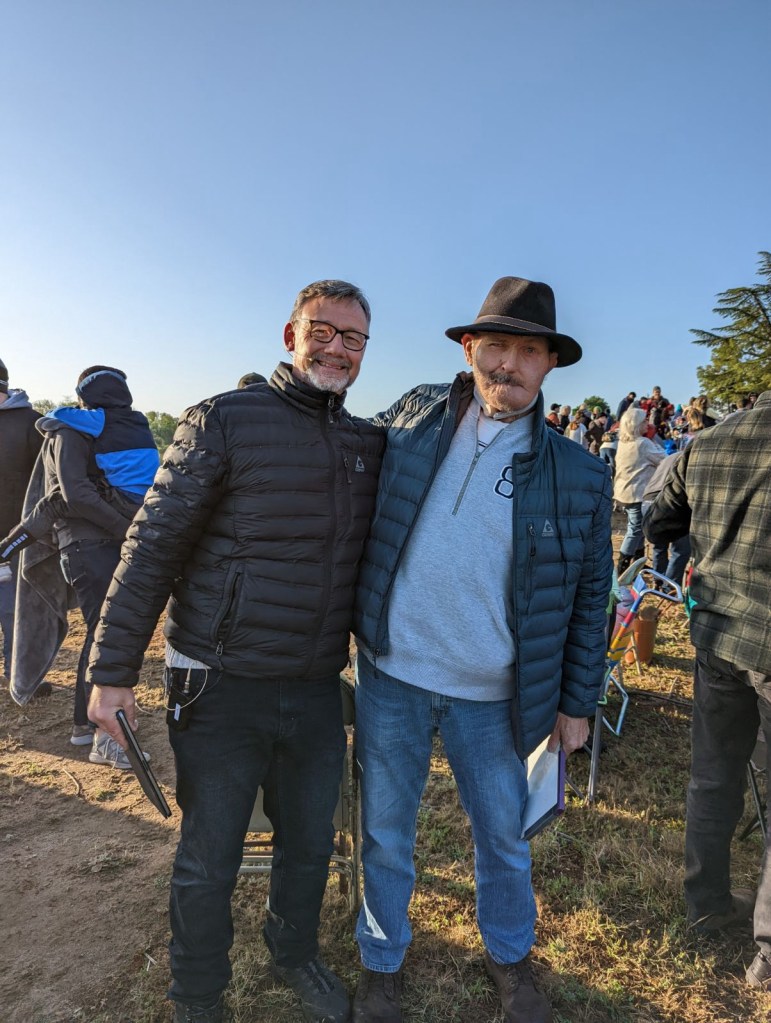
Jim and I at the last sunrise service he was able to attend…

I share this story about Jim because he affected me profoundly. I’ve gotten to know two homeless people fairly well in my life of ministry leadership.  They have taught me much through their stories about our world, humanity, broken systems, and the complexity of homelessness. But I also share Jim’s story because pastors walk with people in great need often. We are introduced to people, our hearts long to help, but we have limited resources.  And, as the family of friends at Jim’s service reminded me, not only are pastors walking with people like Jim, but so are our neighbors!  Unknown to me until his service, he had this group of friends who were meeting all kinds of needs in secret. 

The next time you see your pastor, please remember that they are likely walking with people in all kinds of need. There might be a “Jim” in their lives. And they are carrying that person in their heart and doing their best to help.

I close with words that Robin, one of the women at the service, shared.  She knew Jim when he lived in the tiny home community.  She said:

This small group of people showered abundant love and care on this man.  Jim might have been a test for us…a test of the human experience, to see if there was still compassion. And compassion won.” 

At Jim’s celebration of life, on the American River.
Where we spread Jim’s ashes…and, as per his wishes, we played Luke Bryan’s “Drink a Beer.”

I am now serving with a ministry called Standing Stone, which has aimed for twenty years to provide a space for free, confidential coaching and care for pastors, ministry leaders, and leaders of every sphere. Standing Stone believes that healthy leaders need companions on their leadership journey, and that healthy leaders will lead healthy organizations that help transform their communities. You can learn more here: https://standingstoneministry.org/shepherd/burke-david/

Legos and Jesus

What does it mean to be connected?

I recently had the opportunity to speak at a men’s retreat for a local church. We looked at three stories in the gospel of John, all focusing on the theme of connection. I briefly introduced them to systems theory, and the idea of differentiating yourself in the midst of uncertainty and anxiety (thank you Steve Cuss!). Differentiation, according to Trisha Taylor, means being defined and connected.

Defined:  Who I am, What I will Do, What I Won’t Do.

Connected:  Still able to be with people who see things differently and difficult people.

I talked about the “Connected Man,” and showed them how Jesus was truly connected—he knew who he was, what he came to do, and stayed connected with others despite their own agendas. I shared with them that people who study systems theory say that Jesus of Nazareth exemplified differentiation the most in human history!

Consider the story we find in John 6. You may have heard the story of Jesus taking five loaves and two fish, and feeding thousands of people. But John includes this interesting ending to the story:

Jesus, knowing that they intended to come and make him king by force, withdrew again to a mountain by himself. (John 6:15)

Have you ever thought about that before? You might say, “Wait, don’t we want Jesus to be king?” This is the height of Jesus’ popularity and influence. He has drawn crowds, showed his power over creation, and provided for their needs. Yet he does not bow down to the agenda the crowd has for him. He would not be the king that the crowd wanted.  But he would be the king of Kings we all need.

If you read through the gospels with this lens of how Jesus stayed true to Himself, and still stayed connected to people, you will be surprised. Again and again, we see verses like this one in John 2:

But Jesus knew what was in their hearts, and he would not let them have power over him. (John 2:24)

Yes, there are times, like the one in John 6, where he withdraws to be alone. But he returns to his disciples, to the crowd, to teach them about God and His kingdom, because He loves them with an everlasting love.

I gave each of the men one of the Lego mini-figures, like the one pictured above. I said, “These mini-figures are only meant to remind you of your need to stay connected.  To God, to your loved ones, and to one another.”

May we look at Jesus with new eyes—the truly Connected One. Who so loved us that He did not allow our ideas of who he should be, nor our agendas for what he should do, to distract him from being the King we all need.

I am now serving with a ministry called Standing Stone, which has aimed for twenty years to provide a space for free, confidential coaching and care for pastors, ministry leaders, and leaders of every sphere. Standing Stone believes that healthy leaders need companions on their leadership journey, and that healthy leaders will lead healthy organizations that help transform their communities. You can learn more here: https://standingstoneministry.org/shepherd/burke-david/

Vomit.

Leaders need to vomit.  Think of me as the bucket.  

Well, a bucket that talks back…and asks good questions.  

I didn’t know that having six kids would be good preparation for coaching and caring for leaders.  Kelsey and I remember a season in which multiple kids in our home had the stomach flu at once.  We set up reclining camp chairs on hardwood floors where they could watch TV, and gave them a “bucket.”  Like the one pictured above.  

What does this have to do with my work?  Simply this: I have noticed recently how often leaders will pour out something on their mind and heart, pause, and then say:

“I’m sorry to vomit that all over you.”

It is the same over and over again.  

“Wow, I didn’t mean to vomit all of that on you.”

“Thanks for letting me vomit all of that on you.”

It’s an interesting choice of words, isn’t it?  When we finally have a chance to talk to someone we can trust, someone who listens intentionally, we find ourselves pouring out all kinds of things we’ve been holding in.  That is what I am finding as I begin more of my work with leaders in different spheres.  Intentional listening plus powerful questions often unlock things deep inside of us.  Things that need to get out.  

And, like we often feel when we are physically sick, there is something about talking out loud—“vomiting all of that”—that makes us feel better.  I often will ask, “As you hear yourself saying that, what comes to mind?”  The answers bring insight, new thinking, and often new commitments to change.  

I count it a privilege to be the bucket that listens, asks questions, and makes observations that lead to growth.  

(And did everyone else grow up with using a stainless steel bowl?)

I am now serving with a ministry called Standing Stone, which has aimed for twenty years to provide a space for free, confidential coaching and care for pastors, ministry leaders, and leaders of every sphere. Standing Stone believes that healthy leaders need companions on their leadership journey, and that healthy leaders will lead healthy organizations that help transform their communities. You can learn more here: https://standingstoneministry.org/shepherd/burke-david/

Help Me Help Them!

“Help me, help you!”

This phrase was immortalized by Tom Cruise in the movie Jerry Maguire.  Maguire is a professional sports agent who has one client, wide receiver Rod Tidwell (played by Cuba Gooding Jr.).  In one scene, Maguire is exasperated at the antics of his only client, pleading with Tidwell to understand how hard it is for an agent to land the big contract extension and endorsements for a player.  “Help me, help you!” he repeats, over and over again.

I want to invite you into this journey of coaching and caring for leaders by saying:

“Help me, help them.”

Help me help those in leadership.  

My desire is to guide leaders towards health and wholeness.  

Helping them rediscover the unique design and purpose of their leadership.

So, let me ask you:

What things do you think are needed for leaders to be refreshed?

How do leaders need to receive care?

What do you think is one of the greatest needs for your pastor?

What tools have you used that have helped you discover how you are uniquely made?

What things combined to make you discover your primary calling or purpose?  

What do you think leaders need to guard against that might draw them away from that primary purpose?

Pick any or all of these, and please send me a message…I’d love to know your thoughts!  I want to be well-equipped to help those in multiple spheres of leadership.  

You can also help me help them by giving financially.  I’m currently at 70% of my monthly goal of financial support.  Once I reach the “fully funded” mark, I’ll be able to receive more leaders that are reaching out to Standing Stone for this kind of help.  On a regional Zoom meeting I was on recently, we heard from our area director that they are seeing a marked increase in pastors asking for help on their website forms.

So, help me help them!

I look forward to hearing from you.

[You can email me at david.burke@standingstoneministry.org]

My Website With Standing Stone

3 [More] Reasons Why Leaders Don’t Seek Help

Last week, I wrote about why leaders—and perhaps ministry leaders in particular—don’t seek the help of counselors, therapists, spiritual directors, or coaches. Those 3 reasons were:

  1. Sunday is always coming.
  2. It feels “selfish” to take care of yourself.
  3. Cost and expense.

This week, I want to offer three more reasons why these leaders find it so hard to ask for help.  There are probably a myriad of reasons, but these are a few that hit home.

  1. It feels like “weakness” to admit we need help.  Sure, we can preach on a passage that says, “When I am weak, then I am strong,” but actually confessing our exhaustion, need for rest, or feelings of isolation can make us worry that people might think we are not capable as leaders.  Leaders are supposed to exude certainty and strength, right?  What happens when we are uncertain and feel depleted?  
  2. Sometimes we live in an organizational culture that is marked by overwork.  We may work amongst those that are always doing more, staying later, and will do whatever it takes to move the mission forward.  To be the one staff member who is asking for time off, a sabbatical, or just a day to regroup after a hectic season can feel risky, and we might feel something is “wrong” with us when we longing for recovery time. 
  3. Do we believe that just “talking about it” will really help?  We have most likely been asked the question:  “Does prayer really DO anything?”  Likewise, we might wonder if just talking to someone will really “do” anything to help.  Sure, people might come to us, seeking counsel, wisdom, compassion, and prayer.  But do we trust that going to someone else for the same things will be worth it?

I want to help guide leaders towards their wholeness, by helping them discover—or re-discover—their unique design and purpose.

I am now serving with a ministry called Standing Stone, which has aimed for twenty years to provide a space for free, confidential coaching and care for pastors, ministry leaders, and leaders of every sphere. Standing Stone believes that healthy leaders need companions on their leadership journey, and that healthy leaders will lead healthy organizations that help transform their communities. You can learn more here: https://standingstoneministry.org/shepherd/burke-david/

3 Reasons Why Leaders Don’t Seek Help

In 2015, 38% of pastors used to seek out help from therapists, counselors, spiritual directors several times a month.  Now, according to the most recent Barna research, only 18% do.  Why is that?  

Leaders in other spaces seem to be growing in their awareness of needing help. According to this study, 32% of chief executive officers seek the help of an executive counselor, and 22% receive assistance from a psychologist or therapists. Here are three reasons why I think pastors in particular don’t seek out help from counselors, therapists, spiritual directors, or mentors.

First,

  1. Sunday is always coming. 

The rhythm of leading worship and preaching every week is constant.  And, attendance at those weekly services may be one of the few tangible markers pastoral leaders have in measuring the effectiveness of their ministry.  The internal pressure to be prepared for weekly worship is heavy.  

While some preachers make public speaking look effortless, research has shown that it takes a toll on people.  Archibald Hart has written about the “adrenaline let down,” a physiological phenomenon that brings fatigue, emotional depletion, and a sense of emptiness.  

Pastors and ministry leaders may learn to “push through,” and not address these recurring symptoms of stress, because “Sunday is coming.”

  1. It feels “selfish” to take care of yourself

I took a cross-country flight recently.  This might be an overused analogy, but you may have heard this:  “Put on your own air mask before helping others.”  The lesson here is simple:  if we don’t take the time to keep ourselves healthy, we will not be able to really help others.  

Those in all helping professions probably have something within them that is geared to notice others’ needs and move to bring healing to them.  Ironically, those same people may not be tuned to notice their own needs.  Could it be that the internal and external rewards they receive from being a help to others outweigh the voice that tells them to slow down and take care of themselves?

The season of the Covid pandemic forced so many leaders to adapt quickly.  Then, when things normalized, there was tremendous pressure for church leaders to “get people back to church again.”  Many churches haven’t fully recovered.  To take time away for help feels selfish in the midst of unfinished work.  

There is also still a lingering stigma of counseling, or therapy.  Leaders may wonder if others are asking:  “Why would a person whose calling is to direct a group of people spiritually need their own spiritual director?”

  1. Cost and expense

It was both the encouragement, and the generous financial gift, of one couple in the church that I served that got me to consider getting help from an executive coach.  The two coaches that I ended up working with helped me immensely over the course of four years.  If I had to pay for that out of my own pocket, I don’t believe I would have pursued it.  With a large family, making ends meet was already a challenge.  Having never had a coach before, I’m not sure I could have justified the expense because I didn’t yet know the benefits. 

Those coaches (here and here!) gave me a space to talk openly and honestly.  I learned a great deal about myself and how I get in my own way in leadership.  They asked powerful questions, helping me discern so many things, and bring a healthier version of myself into leadership. 

Their influence was a help in me deciding to become a coach myself.  My hope is to find those who are willing to invest in their own life and leadership health and guide them into a greater wholeness.  

I am now serving with a ministry called Standing Stone, which has aimed for twenty years to provide a space for free, confidential coaching and care for pastors, ministry leaders, and leaders of every sphere. Standing Stone believes that healthy leaders need companions on their leadership journey, and that healthy leaders will lead healthy organizations that help transform their communities. You can learn more here: https://standingstoneministry.org/shepherd/burke-david/