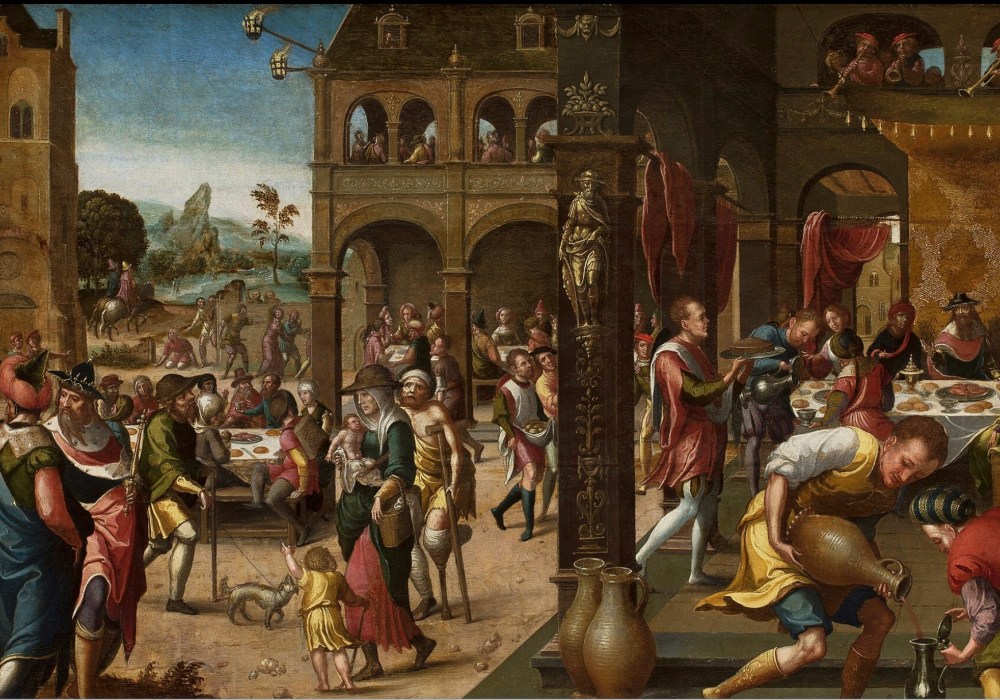
Go out to the roads and country lanes and compel them to come in, so that my house will be full. Luke 14:23
This parable is one that expresses the heart of God—who wants a full house at His banquet table. But it is also a warning from Jesus, that many will make excuses not to join the life that He offers. The parable follows a brief teaching from Jesus who is at a table, having been invited by a Pharisee to a dinner. Jesus notices both how people sat themselves according to what place they thought they deserved. He goes on to challenge people with some upside-down kingdom of God values. Namely, to invite some unlikely guests:
But when you give a banquet, invite the poor, the crippled, the lame, the blind, and you will be blessed. Luke 14:13-14
What Jesus is challenging here is the practice of being generous to others, with the hope that they in turn will be generous to you. Jesus is looking for hearts that give generously just to give. Not to gain recognition, or repayment.
Jesus is also asking people to sit at a table with those that his culture thought were cursed by God. Illness and differing abilities were thought to be a judgment by God, and Jesus constantly sought to reverse that thinking. Instead, Jesus repeatedly treated people as those who were made in the image of God.
Do to others as you would have them do to you. Luke 6:27, 30-31
Love of enemies—according to Dr. Martin Luther King Jr.—is an absolute necessity. At first glance, these words of Jesus seem unrealistic, don’t they? As Dr. King said, are they just the pious words of a utopian dreamer? We can see the context of when Dr. King was writing. He was speaking for racial reconciliation and equality, a struggle that continues today. There were enemies of that message—within and outside the church.
What about today? With conflicts between Israel and Gaza dominating the headlines, we almost forget about Ukraine and Russia. Ethiopia’s Amhara region is dealing with armed conflict and casualties. Gang violence in Haiti seems to be reaching new levels of destruction. People in each of those regions may clearly be able to articulate who their enemies are.
Could the words of Jesus—love of enemies—actually do some good? Or are they simply the words of a dreamer? These teachings show one aspect of the character of Jesus—his generosity.
The generosity of Jesus is shown not only in his attitude towards money and possessions, but in how we treat one another. Because we trust in the love and provision of God our Father, we are free to love even those who oppose us, and give to those who ask.
This passage is found in Luke’s gospel with similar language to Matthew’s Sermon on the Mount. And the Sermon on the Mount (Matthew 5-7) is a description of the upside-down kingdom of God, and the person who is living within the rule of God’s kingdom. These statements are not meant to be legalistic rules, but descriptions of what a person who is living confidently and squarely in the rule and reign of God. Dallas Willard says it like this: “All is changed when we realize that these are illustrations of what a certain kind of person, the kingdom person, will characteristically do in such situations.” (The Divine Conspiracy)
Jesus’ words were meant to make us ask this question: “What kind of person is able to do these things?” Or, “What would have to be present in my life for me to be able to respond to requests for help like this?” For one, a certainty that God is the provider for all my needs. Also, a recognition that my enemy, or the one requesting help, is a human being created in the image of God, broken and in need of God’s grace and love, just like me. Let’s be clear…this path that Jesus is laying out is not an easy one. But we see him living out his own words time and time again.
May we embrace this call to be generous like Jesus.
The former things will not be remembered, nor will they come to mind.
But be glad and rejoice forever in what I will create,
for I will create Jerusalem to be a delight and its people a joy.
I will rejoice over Jerusalem and take delight in my people;
the sound of weeping and of crying will be heard in it no more.
Isaiah 65:17-19
For the last several weeks, we’ve been talking about a God who is “With and For the City,” and reminding us of our call to be “With and For” our city as well. The last book of the Bible gives us a picture of a new city, where there is no more death, no more crying, no more pain (see Revelation 21:4).
Isaiah gave us this same promise hundreds of years before Jesus walked on earth. Jesus showed the glimpse of this new reality as people who were held captive by illness, disease and evil were set free. And we learn in the Book of Revelation that it is this same Jesus who is at the center of this new heaven and new earth.
Though the story of human cities pictured in the Bible and in world history beyond is a checkered one to say the least, God’s plan includes restored cities marked by His peace, life, wholeness, abundance, love between humanity and God and with one another. These words and more come close to understanding the idea of the Hebrew word shalom. Constant in God’s plan is both a people—renamed and renewed—and a place—restored and made beautiful.
The picture in Isaiah 65:17-25 (read the whole passage!) is truly remarkable. Consider some of the promises: No more weeping and crying. No more infant deaths or decline of our bodies due to old age. We will enjoy the work of our hands. Parenting—get this—is a joy! And creation is no longer at odds with one another. Indeed, may this new heaven and new earth come quickly.
May we continue the work that God is creating in the world, as we long for the day of new creation.
I want to confess something. I’m a sucker for those articles that talk about “The Most Desirable Cities in California.” I always want to see Sacramento towards the top of the list. Though I did not grow up here, it has been home for me and my family for nine years. I see it trying to establish an identity, seeking to draw in people from other parts of our country and state. There have been plans for our downtown waterfront, plans for new professional sports teams, plans for more affordable housing, and more—these are all attempts to be a city that is “sought after.”
We’ve seen over the past few weeks that God has a heart for the city, especially one in which there has been devastation and brokenness. Again and again, the people who call on God’s Name are the agents of restoration. Again and again, God renames His people to fit their new identity as ones that accomplish His mission of rebuilding.
This may be unfamiliar territory for us in our journey of faith. But when we read Isaiah 62: 1-12, we see a foreshadowing of what our Lord Jesus Christ has done for us: salvation, a new name, a bridegroom and a bride. And one day, we trust that when He returns, we indeed will see a new city that looks like a garden, and God’s dwelling place will be with us. To be clear, we don’t hasten His return by doing the work of restoration in our cities. But we are clearly called to restore what is broken to show the heart of God, who is With and For Us and His creation.
I’ve always loved this passage. But even more so since moving here nine years ago to the “City of Trees,” where live oaks, valley oaks, and blue oaks thrive and grow. In our region that lives under heat for months at a time, how many of us have enjoyed the cool shade under the branches of an oak tree?
I love the imagery of how God’s Anointed (see Isaiah 61:1-2) is the agent of restoration, that leads to building a people who display the Lord’s splendor and glory. The opening words of the chapter may sound familiar, as they are the words that Jesus read when he began his public ministry.
Isaiah the prophet shifts his imagery quickly from oaks to a people that rebuild cities. Our faith is built on a strong foundation of righteousness, given to us by the righteousness of our Savior Jesus. But our faith is meant to be active, as we are called to rebuild, restore, and renew. Our eyes should be drawn to the places in our neighborhoods and cities where we see brokenness, and our feet should move to be a part of the restoration.
May we have eyes to see what God sees, and may we be “With and For” the city in which we live!
God is interested in R&R. Rest and relaxation yes! After all, God is the one who gave the gift of Sabbath rest for His people. But God is also interested in another kind of R&R—Repair and Restoration.
Isaiah 58 is clear—God is more interested in a community of people living rightly by treating workers fairly, working for justice, providing for the poor and hungry—than He is in seeing a group of people engage in religious activity, such as fasting. Ouch.
Rather, our practices of our faith are meant to produce in us a certain way of living, powered by God’s grace. We reach out with tangible forgiveness and freedom because we have been truly set free and forgiven by Christ. And, because we believe that God is With and For our City, we work to accomplish His mission of restoration where we live.
Isaiah 58 ends with a beautiful renaming of God’s people: Repairer of Broken Walls, Restorer of Streets with Dwellings.
Have you ever been back to your hometown, for instance, and visited a place that you knew as a child to be abandoned, destroyed, or dilapidated? Then, when you visited years later, you saw it bustling with life, with restored streets and buildings? Note: have you ever seen this done in a way that DID NOT cast out long-time residents, but included and honored the history there? THAT image is what the prophet Isaiah is saying to God’s people. That is our calling. To be ambassadors for our cities, seeing God’s beauty and restoration reach into every pocket of our communities.
As you consider these words, what pockets of your community need beauty and restoration? What could you do, and what could we do together?
May it be said of us as a community of followers of Jesus—that we are the Repairers and Restorers!
Zion said, “The Lord has forsaken me, the Lord has forgotten me.”
“Can a mother forget the baby at her breast
and have no compassion on the child she has borne?
Though she may forget, I will not forget you!
See, I have engraved you on the palms of my hands;
your walls are ever before me.
Isaiah 49:14-16
Wait…God engraved the name of a city on the palms of His hands? Like a tattoo? Some commentaries say this metaphor could be that. This Hebrew word is only used here in this passage. The word means to carve and inscribe, like on a stone tablet. Hmmm. Yes, this is a metaphor, but a powerful one.
The prophet Isaiah speaks of Zion—an often-used synonym for the city Jerusalem—as having been forgotten by God. But God has another plan.
When you think of cities in the Bible, what images come to mind?
We may first think of the Tower of Babel in the book of Genesis, where we see humanity seeking their own glory. Tim Mackie and his team at the Bible Project have been doing remarkable work on the image of city in the Scriptures. I highly encourage you to check out their teaching here: https://bibleproject.com/explore/video/the-city/
What the prophet Isaiah will show us over the next several weeks, is that God looks to restore cities, and will one day bring the Shalom—the abundant peace and well-being of God—to a new heaven and new earth, marked by a “garden-city” in which God Himself will dwell.
This is not mere Bible study—it is a call for us as followers of Jesus to be “With and For” the city in which we dwell.
I live in Sacramento—the City of Trees, the Farm-to-Fork Capital, the Capital of California, the River City—a city by many names. How can we be a part of God’s plan to restore this city?
May we look, and listen, for the ways that God is moving and speaking to us as His people, called to be restorers of the cities. Because God cares for the city.
Ever had that experience of a friend—never you, of course—that attempts to make a joke, only to realize that the timing of that was just a bit too soon to be laughing about it? For example, you see it in sports fans, making fun of another team’s struggles, only to discover its fans are still grieving. (The Seahawks Super Bowl loss to the New England Patriots in 2015 is still “Too Soon” for me).
This might seem like a “hot take,” but I wonder if inviting people that haven’t been to church ever, or if it has been a while—to worship at a church is “too soon.” I mean in the real sense of too soon, NOT the-making-a-joke-kind of “too soon.” That is, those of us that are part of a regular worshipping community don’t understand how strange worship can be. And, our default idea is to just invite our neighbor, co-worker, classmate or friend to church, and let that experience take over. It may be “too soon.”
Over the last several weeks, we’ve talked about how we enter into, and deepen, our apprenticeship to Jesus, and invite others to do the same. I’ve tried to make sure to articulate that this is not THE path, or the ONLY way it works. But, we do see patterns in the Bible, and in our experience, that often this is how things develop. First, we often CONNECT with someone or a group of people that are following Jesus. Then, if interested, we begin to LEARN through them and the Scriptures more about the person of Jesus. In seeing the example of Jesus, and hopefully the practice of that community, we may begin to SERVE out of the gifts and experience that God has given us. I’d like to suggest that there is another aspect of our apprenticeship that is WORSHIP—but that it might come later on the pathway.
In Matthew 28, we are told that two women—Mary Magdalene and “the other Mary”— go to the tomb of Jesus. An angel is sitting on the rolled-back stone that covered the tomb, and his appearance is frightening. The angel speaks to the women, telling them to tell the other disciples that Jesus is risen from the dead. While they hurry away “afraid yet filled with joy,” Jesus himself appears to them. He simply says, “Greetings!” And the women fall down and worship him.
It strikes me that the word “worship” is used sparingly in the gospels and New Testament as a whole. The Book of Revelation uses it the most, which makes sense because it is portraying a vision of things to come—when the fullness of God’s plan is revealed to all of creation.
It seems that worship in the gospels comes mostly after Jesus has risen from the dead. [aside from the Magi worshipping the infant Jesus at his birth and Satan tempting Jesus to worship him]. It is the culmination of seeing the power and plan of God that cause people to bow down and worship. The women in Matthew 28, and the disciples, truly worship when they fully witness the power and plan of God as revealed through the risen Jesus.
I grew up outside the church. I didn’t step foot in one until I was sixteen—unless you count the time my practicing-Catholic grandparents had me attend a service on a cruise ship. I still find it interesting that many people think the first step in inviting a friend or co-worker who may be seeking God is to bring them to church. My own story involved connecting with people who exhibited the love and community of Jesus, beginning to learn by reading the Scriptures on my own and in community. It would be much later that I joined in a worshipping community.
I do not mean to make my experience normative for others. But many others, Alan Hirsch being one*, write about how there is a widening sense of “cultural distance” between people now and the experience of church.
I wonder if seeing worship as a later stage in our path of discipleship to Jesus might make us more patient with others. Or, actually spend more time with them showing the love and grace of Jesus, before inviting them to church. It also may help those of us trying to follow Jesus more deeply, recognizing that we have not allowed certain areas of our lives to bow down to Jesus’ lordship. If this process has truth in it, perhaps we are all learning to worship the risen Jesus fully in all areas of our lives. It has been said by others that we all worship something, but to change the object of our worship might necessitate a longer process of connecting in community, learning, and serving. But—the good news is—that when we allow that process to take place in ourselves and others, the end result will be worshipping the risen Jesus.
We’ve been talking the last few weeks about a “path for discipleship” here at our church. Path means a lot of different things to different people. Some people might interpret it like a formula—-start here, then go here, and you’ll end up here. I think we all know by now that God does not always work in such clear ways in our lives. Yes, there is a process to our growing in the knowledge and love of Christ. But it may start in different places, and it does not “end”—it matures and deepens—but does not “end.”
That is, when you enter into a garden, there are different plantings, but depending on where you enter, and where you are drawn, you may start and linger at one planting before another. A community of followers in a church can be like that ecosystem, providing a variety of plantings to help people grow, but it depends on the person where they start and go next.
Still, we can look at how Jesus brought people into discipleship and apprenticeship with him, and learn from Him. He connected with people, taught them, and then sent them out to serve. And serving is what I want to talk about today.
It is clear from the gospels that Jesus intended his disciples to DO something with their apprenticeship to Him. Early in his training of them, Jesus sent his disciples out to heal, preach, and cast out evil.
The word Jesus chooses is diakonia, which has a connotation of table-service, as seen here: “For who is greater, the one who is at the table or the one who serves? Is it not the one who is at the table? But I am among you as one who serves.” Luke 22:27
Jesus’ followers would have seen daily the example of people sitting at table being seen as having greater honor in society, with those serving food and drink considered lower. Jesus was telling (and showing) his disciples to adopt the attitude of being a servant, to seek the good of others by serving them.
In our growing and learning from Jesus, we should reach a place where we begin to look for ways to serve others. Regardless of the perceived status of the serving, followers of Jesus can grow into a place of seeking out opportunities to bless others. Whether it be tangibly helping a family in crisis by making a meal, spending time with children in a nursery or volunteering in a school, visiting a home-bound friend, cleaning up a local park—there are countless ways to serve.
Ask any school aged child or teenager, and you’ll rarely get any of them to say that their schooling feels like freedom. [Of course, ask any child in a different culture for whom school has been kept from them, and you’ll get a different answer!]
But what if some teaching is better than others?
Jesus said, “If you hold to my teaching, you are really my disciples. Then you will know the truth, and the truth will set you free.” John 8:31
In previous notes/posts, we’ve talked about how integral Jesus’ teaching is to being a learner of Jesus. Jesus taught primarily about the kingdom of God, because he wanted to correct false assumptions about the character of God, and wanted to proclaim a message of good news about what God was doing, and will do, in the world. Through many illustrations, he talked about what the kingdom is like, what God is like, and the unexpected nature of the kingdom and its availability to those considered to be on the outside.
Here, we see Jesus telling us plainly that holding to his teaching is a marker of discipleship. And, the truth of his teaching will free us from the things that enslave us.
Of course the crowd that first heard these words argued with Jesus. They focused on the last word—free—and argued that they weren’t slaves. We might have the same reaction. We have a hard time identifying the things that hold us captive. We say we can quit [coffee, gossiping about others, social media, Netflix shows, fill in the blank] anytime, until someone actually challenges us to do that.
I did a little digging into the first part of Jesus’ words here. When he says “teaching” the word used is logos. When he says “hold to” the word is meno, which means to remain, dwell, or abide.
Jesus says something similar a few chapters later when he says:
“Anyone who loves me will obey my teaching. My Father will love them, and we will come to them and make our home with them.” John 14:23
The word “home” comes from the same root as meno, to dwell or abide.
It seems that Jesus is saying that if and when we dwell in his words, his teaching, his message, that in turn the Father and Son will dwell in us. And, the idea that truly living in the words and teachings of Jesus sets us free from things that enslave us is a profound one.
May we give ourselves to the teaching of Jesus, and find the truth that brings freedom.