Love your enemies…
Give to everyone who asks you…
Do to others as you would have them do to you. Luke 6:27, 30-31
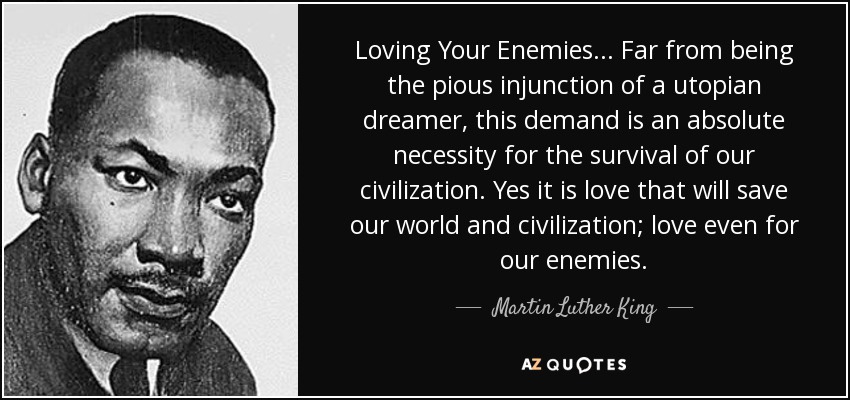
Love of enemies—according to Dr. Martin Luther King Jr.—is an absolute necessity. At first glance, these words of Jesus seem unrealistic, don’t they? As Dr. King said, are they just the pious words of a utopian dreamer? We can see the context of when Dr. King was writing. He was speaking for racial reconciliation and equality, a struggle that continues today. There were enemies of that message—within and outside the church.
What about today? With conflicts between Israel and Gaza dominating the headlines, we almost forget about Ukraine and Russia. Ethiopia’s Amhara region is dealing with armed conflict and casualties. Gang violence in Haiti seems to be reaching new levels of destruction. People in each of those regions may clearly be able to articulate who their enemies are.
Could the words of Jesus—love of enemies—actually do some good? Or are they simply the words of a dreamer? These teachings show one aspect of the character of Jesus—his generosity.
The generosity of Jesus is shown not only in his attitude towards money and possessions, but in how we treat one another. Because we trust in the love and provision of God our Father, we are free to love even those who oppose us, and give to those who ask.
This passage is found in Luke’s gospel with similar language to Matthew’s Sermon on the Mount. And the Sermon on the Mount (Matthew 5-7) is a description of the upside-down kingdom of God, and the person who is living within the rule of God’s kingdom. These statements are not meant to be legalistic rules, but descriptions of what a person who is living confidently and squarely in the rule and reign of God. Dallas Willard says it like this: “All is changed when we realize that these are illustrations of what a certain kind of person, the kingdom person, will characteristically do in such situations.” (The Divine Conspiracy)
Jesus’ words were meant to make us ask this question: “What kind of person is able to do these things?” Or, “What would have to be present in my life for me to be able to respond to requests for help like this?” For one, a certainty that God is the provider for all my needs. Also, a recognition that my enemy, or the one requesting help, is a human being created in the image of God, broken and in need of God’s grace and love, just like me. Let’s be clear…this path that Jesus is laying out is not an easy one. But we see him living out his own words time and time again.
May we embrace this call to be generous like Jesus.
Grace and peace,
David
 david j burke