A New Thing

“Behold, I am doing a new thing.” ~Isaiah 43:19

After twenty-six years of being a campus minister and pastor, I am about to do something new.

As of December 31st, I am stepping down from my role as Senior Pastor at Fremont Presbyterian Church, a role I’ve held since September 2014.

What is the new thing?
I want to help leaders in all spheres—the local church, ministries, nonprofits, and for-profit organizations—by providing free confidential coaching and care. I will be working with Standing Stone Ministires beginning in early 2024. @standing_stone_ministry has over 200 people serving 3,000 leaders nationally.

We all raise our financial support so we can provide this service to any leader, free of charge.

Throughout the various roles I’ve held, I have aimed to listen well, care deeply, and guide with wisdom. I know that leadership in all areas of life can feel lonely.

Earlier this year, someone said to me, “David, it sounds like you are longing for the hidden work of deeper discipleship.” I am ready for the behind-the-scenes conversations that help keep leaders healthy, and take people deeper into the knowledge and love of Jesus.

This link gives you an opportunity to donate.
https://standingstoneministry.org/shepherd/burke-david/

My hope is to have a team of partners with me in this ministry. Not just donors, but partners.

If you see the need for this kind of work, I’d love to connect with you and tell you more.

Generous Like Jesus—Four Times More

James Tissot (Nantes, France, 1836–1902, Chenecey-Buillon, France).
Zacchaeus in the Sycamore Awaiting the Passage of Jesus. Brooklyn Museum.


“Look, Lord! Here and now I give half of my possessions to the poor, and if I have cheated anybody out of anything, I will pay back four times the amount.” Luke 19:8

This week, we look at the story of Zacchaeus, whose short stature is the subject of many a Sunday school song and story! (Sorry if you just got that “wee little man” lyric stuck in your head now…if you know, you know). But Zacchaeus being short and climbing a sycamore tree to see Jesus is not the main point of this story. Jesus invites himself over(!) to his house, even though Zacchaeus’ role as a tax collector made him a hated figure in his town. Sitting at table with someone conveyed all kinds of messages.

In the story, we are not given any clue as to what motivated Zacchaeus to be so generous.  Was it simply because he was in the presence of Jesus?  Were there words exchanged between guest-Jesus and host-Zacchaeus that led to Zacchaeus’ repentance?  We do not know.  

What follows is a beautiful proclamation:

“Today salvation has come to this house, because this man, too, is a son of Abraham. For the Son of Man came to seek and to save the lost.” Luke 19:9-10

Jesus proclaims that salvation has come:  some scholars wonder if Jesus is referring to himself here, or if the act of repentance by Zacchaeus is truly evidence of a changed heart.  Zacchaeus is declared to be a part of a family—a son of Abraham. And then Jesus declares his mission statement—to seek and save the lost.

Zacchaeus teaches us something.  In the presence of Jesus, he is moved towards a generous heart, to repay whatever he has cheated, even four times more.  In the presence of Jesus, he hears that he belongs to a family.  In the presence of Jesus, he knows he has been found.

May we celebrate the grace and love of our Lord, and learn from Zacchaeus and his changed life!

Grace and peace,

David

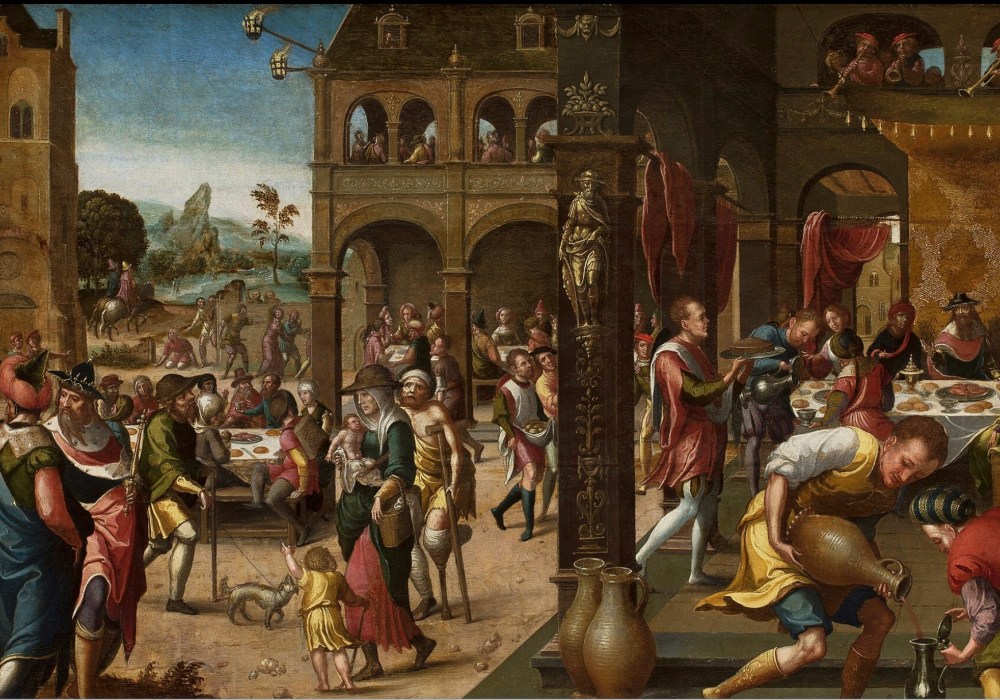
Generous Like Jesus: A Great Banquet

Parable of the Great Banquet by Brunswick Monogrammist (circa 1525)

Go out to the roads and country lanes and compel them to come in, so that my house will be full. Luke 14:23

This parable is one that expresses the heart of God—who wants a full house at His banquet table. But it is also a warning from Jesus, that many will make excuses not to join the life that He offers. The parable follows a brief teaching from Jesus who is at a table, having been invited by a Pharisee to a dinner. Jesus notices both how people sat themselves according to what place they thought they deserved. He goes on to challenge people with some upside-down kingdom of God values. Namely, to invite some unlikely guests:

But when you give a banquet, invite the poor, the crippled, the lame, the blind, and you will be blessed. Luke 14:13-14

What Jesus is challenging here is the practice of being generous to others, with the hope that they in turn will be generous to you. Jesus is looking for hearts that give generously just to give. Not to gain recognition, or repayment.

Jesus is also asking people to sit at a table with those that his culture thought were cursed by God. Illness and differing abilities were thought to be a judgment by God, and Jesus constantly sought to reverse that thinking. Instead, Jesus repeatedly treated people as those who were made in the image of God.

Who is God calling us to invite to our table?  

Grace and peace,

David

Generous Like Jesus: Love and Lend

Love your enemies…

Give to everyone who asks you…

Do to others as you would have them do to you. Luke 6:27, 30-31

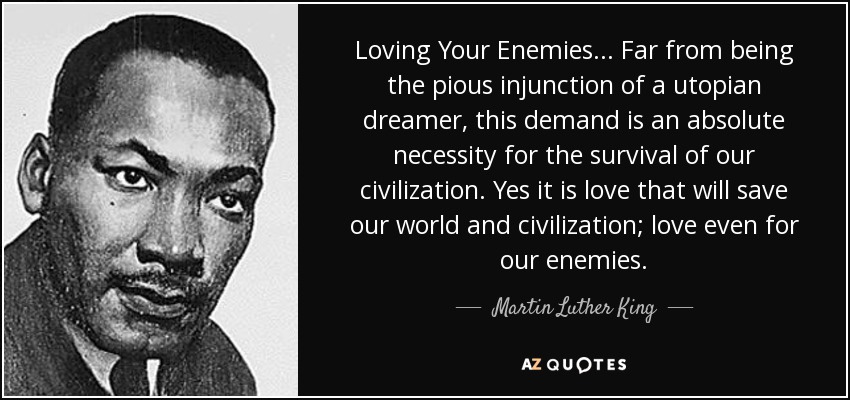
Love of enemies—according to Dr. Martin Luther King Jr.—is an absolute necessity. At first glance, these words of Jesus seem unrealistic, don’t they? As Dr. King said, are they just the pious words of a utopian dreamer? We can see the context of when Dr. King was writing. He was speaking for racial reconciliation and equality, a struggle that continues today. There were enemies of that message—within and outside the church.

What about today? With conflicts between Israel and Gaza dominating the headlines, we almost forget about Ukraine and Russia. Ethiopia’s Amhara region is dealing with armed conflict and casualties. Gang violence in Haiti seems to be reaching new levels of destruction. People in each of those regions may clearly be able to articulate who their enemies are.

Could the words of Jesus—love of enemies—actually do some good? Or are they simply the words of a dreamer? These teachings show one aspect of the character of Jesus—his generosity.

The generosity of Jesus is shown not only in his attitude towards money and possessions, but in how we treat one another. Because we trust in the love and provision of God our Father, we are free to love even those who oppose us, and give to those who ask.

This passage is found in Luke’s gospel with similar language to Matthew’s Sermon on the Mount. And the Sermon on the Mount (Matthew 5-7) is a description of the upside-down kingdom of God, and the person who is living within the rule of God’s kingdom. These statements are not meant to be legalistic rules, but descriptions of what a person who is living confidently and squarely in the rule and reign of God. Dallas Willard says it like this: “All is changed when we realize that these are illustrations of what a certain kind of person, the kingdom person, will characteristically do in such situations.” (The Divine Conspiracy)

Jesus’ words were meant to make us ask this question:  “What kind of person is able to do these things?”  Or, “What would have to be present in my life for me to be able to respond to requests for help like this?”  For one, a certainty that God is the provider for all my needs.  Also, a recognition that my enemy, or the one requesting help, is a human being created in the image of God, broken and in need of God’s grace and love, just like me.  Let’s be clear…this path that Jesus is laying out is not an easy one.  But we see him living out his own words time and time again.

May we embrace this call to be generous like Jesus.

Grace and peace,

David